The term “inspection" refers to a conformity assessment based on defined or general requirements. Products (machines or devices), processes or installations (equipment) can be inspected.
An inspection aims at demonstrating the safety and performance of the inspected target. Typical examples of inspection targets include lifts, hoisting devices, different types of pressure equipment, measuring instruments, fire extinguishers and fire detectors.
An inspection can be performed when the machine, device or piece of equipment is being commissioned (a commissioning inspection), as part of the periodical verification of performance and safety (a periodic inspection) or in connection with modifications (a modification inspection).
In connection with accreditation, inspection bodies are classified into three different types, A, B and C. The type is specified based on the interdependence between the inspection body and the inspection target. Inspection bodies falling in type A are independent and impartial third parties. Type B inspection bodies are separate part of an organisation and perform inspections for their parent organisation or organisations belonging to the same group of companies. The separation from the organisation expected from type B inspection bodies is not expected from type C inspection bodies. Furthermore, type C inspection body can supply inspections services to its parent organization or to other parties, or to both. All inspection bodies must carry out inspections impartially.
The quality management system of an accredited inspection body complies with the principles of ISO 9001. The international organisations ISO, ILAC and IAF have stated this compliance in their joint resolution (download pdf).
Requirements and guidelines (updated 4th of August 2026)
The accreditation requirement for inspection bodies:
SFS-EN ISO/IEC 17020:2012 Conformity assessment — Requirements for the operation of various types of bodies performing inspection
A new version of the standard was published in March 2026. The transition period from the previous version, SFS-EN ISO/IEC 17020:2012, to the new version is 3 years. By March 2029, all inspection body accreditations must comply with the new version. Assessments according to the new version will begin at the start of 2027, but already accredited bodies may postpone implementation until 2028.
EA's guides can be found here:
https://european-accreditation.org/publications-and-news/newsroom/
Global ACI's guides can be found here:
https://global-aci.org/en/documents-categories/
Mandatory guidelines relating to accreditation of inspection bodies
- Global ACI-TECH-1-011 Policy on Metrological Traceability of Measurement Results is being updated and ILAC-P10:07/2020 ILAC Policy on Metrological Traceability of Measurement Results is still valid.
- Global ACI-TECH 2-001 Application of ISO/IEC 17020:2012 for the Accreditation of Inspection Bodies is being updated ILAC P15:05/2020 is still valid.
Guidelines relating to inspection bodies
Examples of guidance documents for inspection bodies are given below. The list does not necessarily cover all guidelines prepared for the accredited activities.
- Global ACI-TECH 1-005 Guidelines for the determination of calibration intervals of measuring equipment is being updated (ILAC-G24:2022 Guidelines for the determination of calibration intervals of measuring equipment is still valid).
- Global ACI-TECH 2-002 Guidance on measurements performed as part of an inspection process
Publications of FINAS that support the operations of inspection bodies
Accreditation symbol
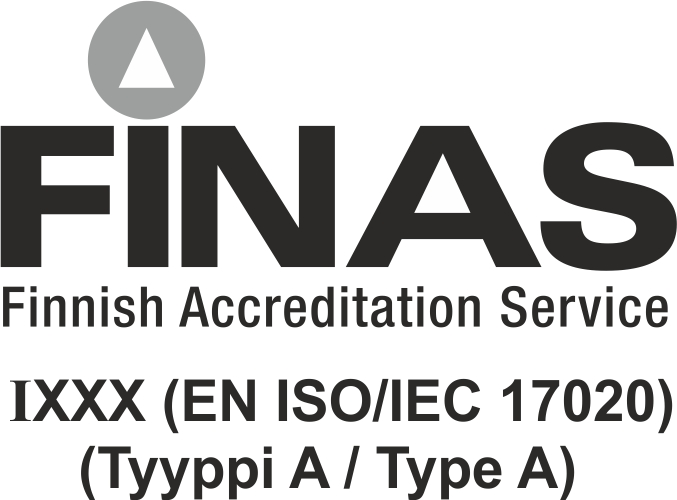
Accredited bodies are entitled to use the FINAS accreditation symbol, which consists of the FINAS logo, the accredited body's identification number and the accreditation requirement. The FINAS accreditation symbol must be used when the accredited body refers to the accreditation in its reports, for example.
Accredited inspection bodies use an identifier in which the identification number of the accredited body is of the format IXXX. The logo also includes a symbol describing the inspection body's independence (A, B or C).